How to Cite Sources: A Complete Guide to APA, MLA and Chicago
Citing sources correctly is one of the most practical skills in academic writing. It tells your reader where your ideas come from, lets them verify your claims, and protects you from plagiarism. But with three major citation styles and dozens of source types, knowing where to start is not always obvious.
This guide explains why citations matter, how in-text citations and reference lists work together, which style to use for your discipline, and where to find detailed guidance for every source type.
Quick Answer
To cite a source, you need two things: an in-text citation at the point where you use the source, and a full reference entry at the end of your paper. The in-text citation is short (usually author and year in APA, or author and page number in MLA). The reference entry contains all the details a reader needs to find the source. Every in-text citation must match one reference entry, and every reference entry must correspond to something cited in your text.
Why Citing Sources Matters
Citations serve three purposes in academic writing.
Credit: When you use someone else's idea, argument, data, or exact words, you give them credit. This is both an ethical obligation and an academic requirement.
Verification: A citation lets your reader find the original source and check whether you have represented it accurately. This is what distinguishes academic writing from opinion.
Traceability: Citations create a chain of evidence. Your reader can follow your argument back through the sources you used to the evidence on which it rests.
Plagiarism is not only copying text word for word. Using someone's idea, argument structure, or data without attribution is also plagiarism, even if you rewrite it in your own words. The rule is simple: if it came from a source, cite it.
How Citations Work: In-Text Citations and Reference Lists
Every citation system uses two components that work together.
The In-Text Citation
The in-text citation appears in the body of your paper, at the exact point where you use information from a source. It is short by design: just enough to point your reader to the full entry.
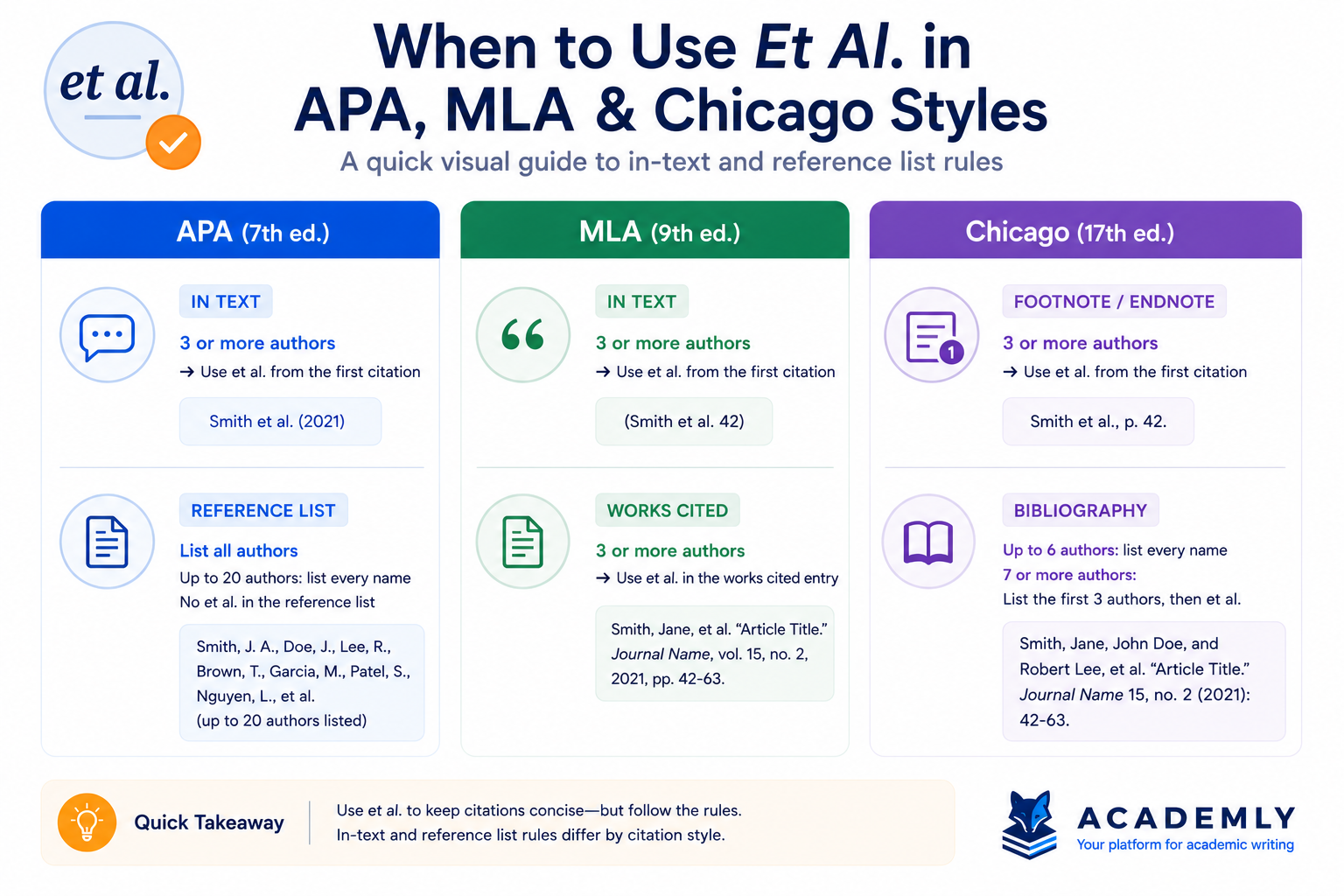
APA format: (Author, Year) or (Author, Year, p. X) for a direct quote MLA format: (Author Page) or (Author) if no page number Chicago format: Footnote number in superscript
The Reference List
The reference list (called Works Cited in MLA, or Bibliography in Chicago) appears at the end of your paper. It contains one full entry for every source cited in the text.
The two must match exactly. If you cite (Smith, 2021) in your text, there must be a reference list entry that begins with Smith and is dated 2021. If a source appears in your reference list, it must be cited somewhere in the text.
What Goes in a Citation
Every citation, regardless of style, captures four core elements:
- Who created the source (author, editor, organization)
- When it was published (year, and sometimes month or day)
- What it is called (title)
- Where to find it (publisher, journal, URL, DOI)
The order and formatting of these elements differs between styles. The elements themselves do not.
Which Citation Style Should You Use?
Your instructor or department will usually specify which style to use. If not, the general conventions by discipline are:
| Discipline | Standard Style |
|---|---|
| Social sciences (psychology, sociology, education) | APA 7th edition |
| Humanities (literature, language, philosophy) | MLA 9th edition |
| History, arts, religion | Chicago Notes-Bibliography |
| Sciences and social sciences (some) | Chicago Author-Date |
| Medicine and health sciences | AMA or Vancouver |
| Engineering and computer science | IEEE |
| Business | APA or Chicago, varies by program |
When in doubt, ask your instructor before you start writing. Switching styles halfway through is time-consuming.
The Three Major Citation Styles
APA (American Psychological Association)
APA is currently in its 7th edition. It uses an author-date system. In-text citations show the author's last name and the year of publication. The reference list is alphabetical. APA is standard in social sciences, education, and psychology.
The authoritative resource is APA Style, which provides verified examples for every source type. Purdue OWL's APA guide is the most widely used free reference for APA formatting.
APA in-text example:
(Smith, 2021, p. 43)
APA reference list example:
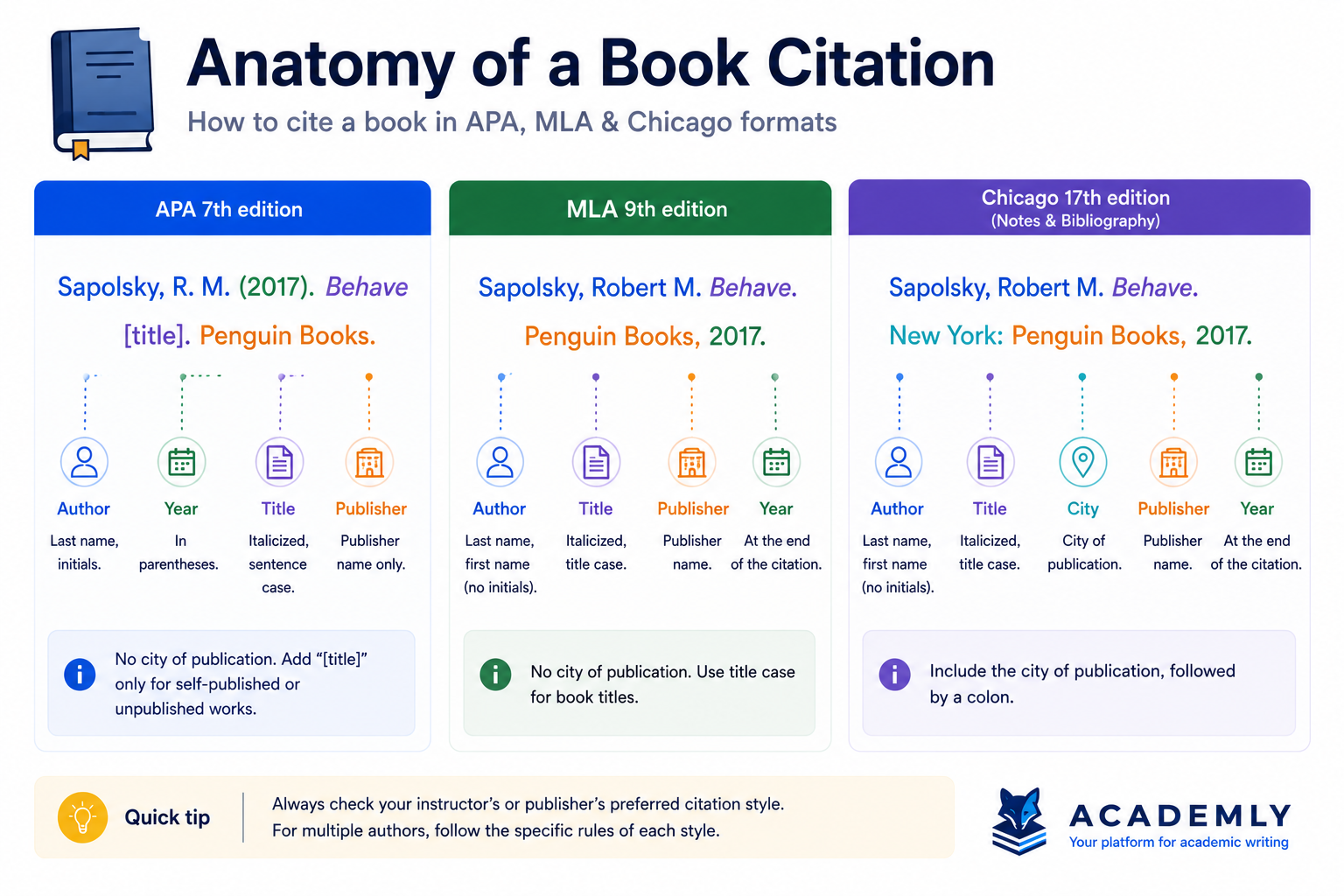
Smith, J. A. (2021). The psychology of learning. Academic Press.
MLA (Modern Language Association)
MLA is currently in its 9th edition. It uses an author-page system. In-text citations show the author's last name and a page number. The reference list is called Works Cited and is alphabetical. MLA is standard in English, literature, and the humanities.
The official source is the MLA Style Center, which provides authoritative guidance and examples. Purdue OWL's MLA guide is the most accessible free reference.
MLA in-text example:
(Smith 43)
MLA Works Cited example:
Smith, Jane A. The Psychology of Learning. Academic Press, 2021.
Chicago (Chicago Manual of Style)
Chicago is currently in its 18th edition (2024). It has two systems. Notes-Bibliography uses numbered footnotes and a bibliography, standard in history and the humanities. Author-Date uses parenthetical citations and a reference list, used in some social sciences.
The official source is the Chicago Manual of Style. Purdue OWL's Chicago guide provides clear examples for both systems.
Chicago footnote example:
- Jane A. Smith, The Psychology of Learning (New York: Academic Press, 2021), 43.
Chicago bibliography example:
Smith, Jane A. The Psychology of Learning. New York: Academic Press, 2021.
How to Cite Different Source Types
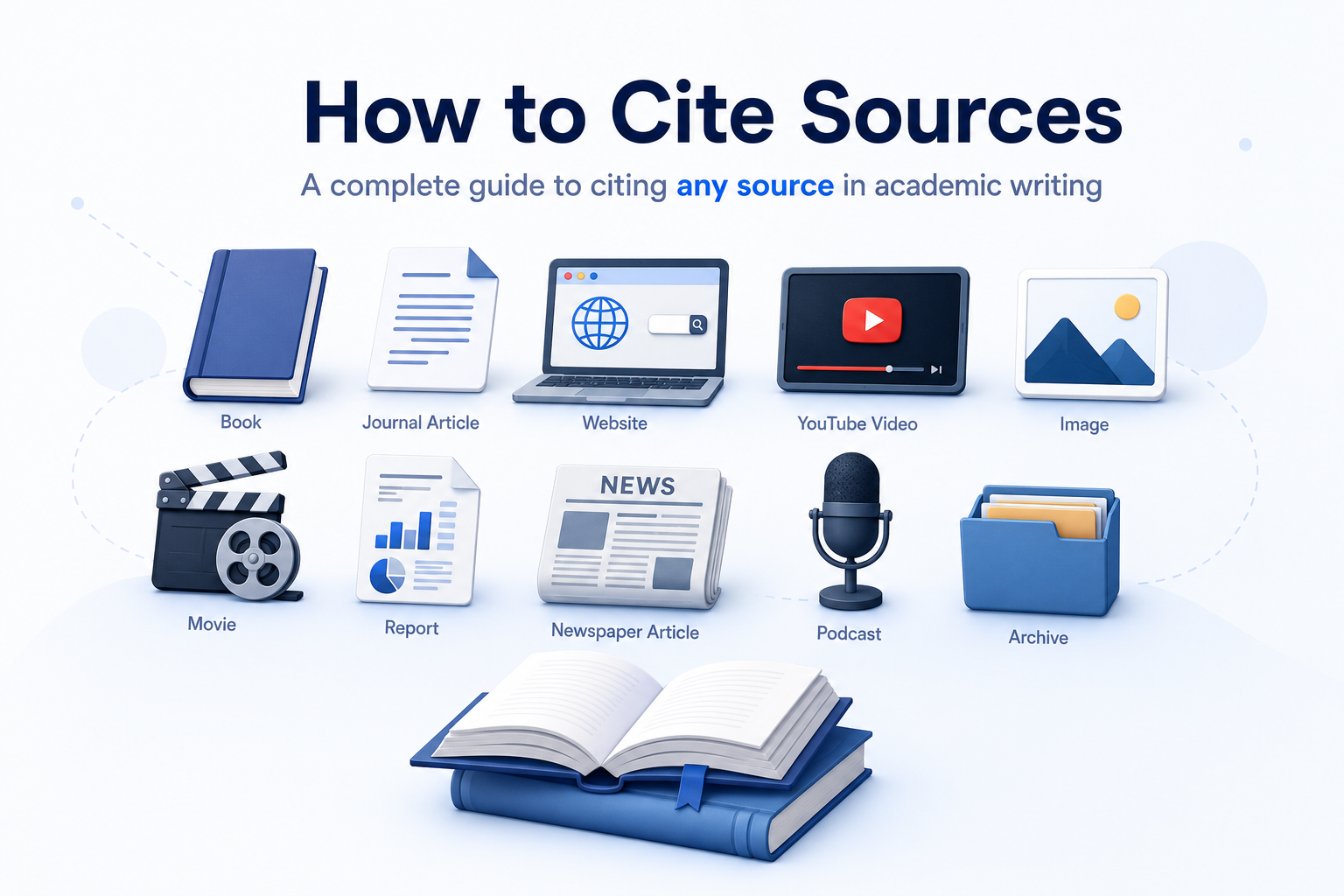
The formatting changes depending on what you are citing. Use the guides below for the most common source types.
| Source Type | Guide |
|---|---|
| Book, textbook, ebook | How to cite a book |
| Journal article, magazine, newspaper | How to cite an article |
| YouTube video or online video | How to cite a YouTube video |
| Film or movie | How to cite a movie |
| Image, photograph, artwork | How to cite an image |
| Website or webpage | How to cite a website (coming soon) |
Paraphrasing vs. Direct Quoting: When to Cite
Both require a citation. The difference is in how you present the information.
Direct quote: You use the source's exact words, enclosed in quotation marks. Always include a page number or timestamp.
"The most important skill in academic writing is not writing itself, but reading carefully" (Smith, 2021, p. 12).
Paraphrase: You restate the idea in your own words and sentence structure. A citation is still required. Do not just swap synonyms: a genuine paraphrase is a full rewrite.
Smith (2021) argues that attentive reading is the foundation of effective academic writing.
When you do not need a citation:
- Common knowledge (the year World War II ended, the capital of France)
- Your own original ideas, analysis, or conclusions
- General observations that are not traceable to a specific source
If you are unsure whether something needs a citation, cite it. The cost of over-citing is minimal. The cost of under-citing is a plagiarism flag.
In-Text Citation: The Most Common Mistakes
1. Citing at the end of a paragraph instead of at the point of use
The citation should appear immediately after the information it supports, not at the end of a paragraph that draws on multiple sources. A reader cannot tell which sentence came from which source if all citations are bundled at the end.
2. Omitting a citation for paraphrased material
Paraphrasing is not a citation-free zone. If the idea came from a source, you need to cite it, even if you rewrote it entirely in your own words.
3. Missing page numbers for direct quotes
APA and MLA both require page numbers for direct quotes. Citing (Smith, 2021) when you have quoted Smith word for word is incomplete.
4. Reference list entries that do not match in-text citations
If your in-text citation says (Johnson & Williams, 2019) but your reference list has "Johnson, Williams, 2019" or the year is different, the citation is broken. Cross-check every in-text citation against the reference list before submitting.
5. Including sources in the reference list that you did not cite
A reference list is not a bibliography of everything you read. It contains only sources you actually cited in the text. If you consulted a source but did not cite it, it does not belong in the reference list.
How to Find the Information You Need for a Citation
For every source you use, collect these details before you start writing:
For a book: Author(s), year, full title, edition (if not first), publisher, DOI or URL if an ebook.
For a journal article: Author(s), year, article title, journal name, volume, issue, page range, DOI.
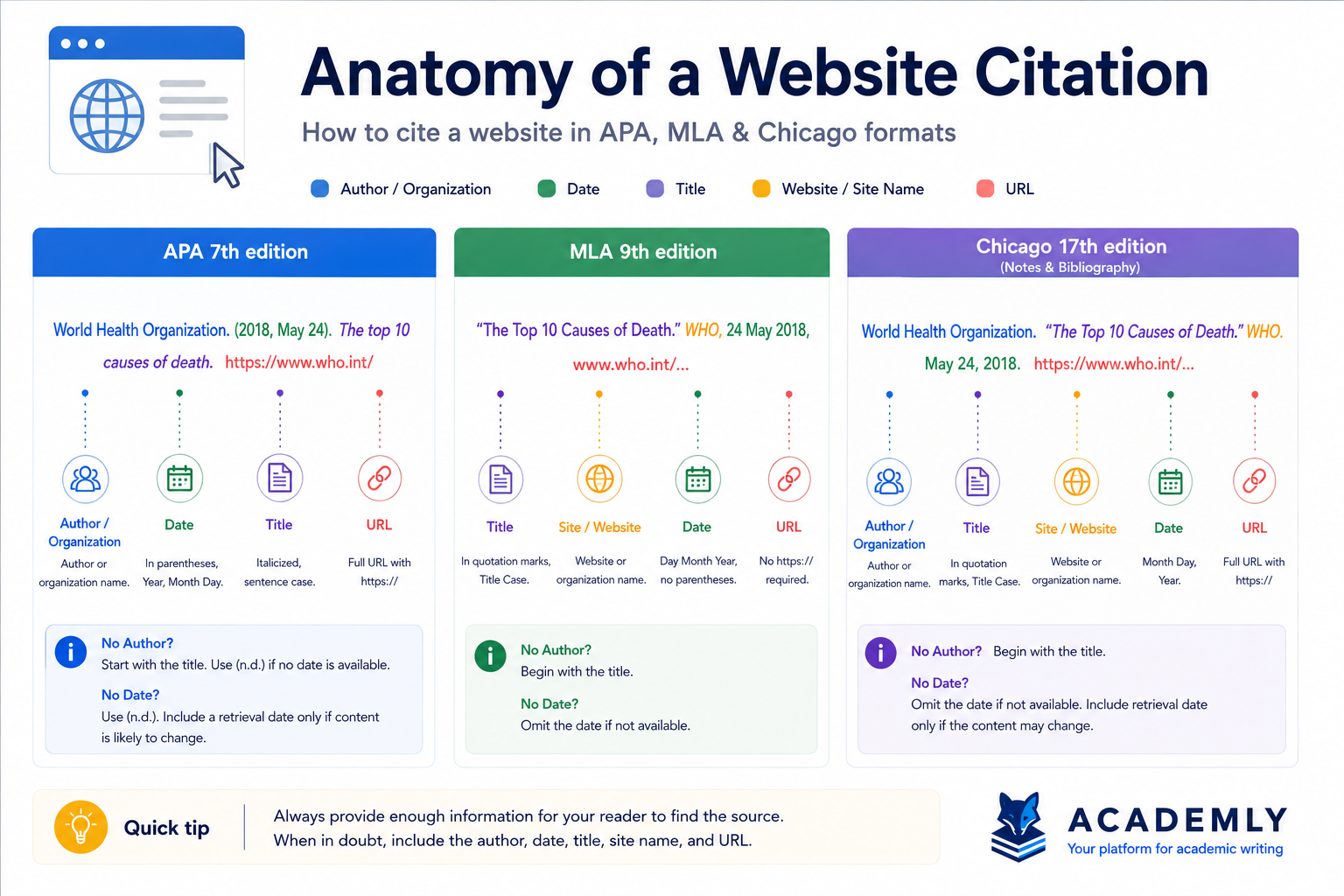
For a website: Author or organization, date published or last updated, page title, website name, URL.
For a video: Creator or channel, upload date, video title, platform, URL.
Do not wait until your paper is finished to collect citation details. Pages move, articles go behind paywalls, and video titles get edited. Capture the information the first time you access the source.
Citation Managers: Organizing Your References
When you are working with more than a handful of sources, tracking citations manually becomes error-prone. Citation managers help you store, organize, and format references automatically.
Zotero is free, open-source, and works with a browser extension that captures citation data directly from databases and websites. It exports in APA, MLA, Chicago, and hundreds of other styles.
Mendeley offers similar functionality with cloud storage and PDF annotation.
EndNote is commonly used in research institutions and supports direct integration with Word.
All three can export references in RIS format, which is compatible with most academic tools. Academly's Citation Manager imports PDFs and parses bibliographic information automatically, then exports in RIS format for use in Zotero, Mendeley, or EndNote: with citations only from sources you have actually uploaded.
Summary
Citing sources requires two things: an in-text citation at the point of use, and a matching reference list entry at the end of the paper. The style (APA, MLA, Chicago) determines the formatting. The four core elements: who, when, what, where: are the same across all styles. The most common mistakes are paraphrasing without citing, omitting page numbers for quotes, and mismatching in-text citations with reference list entries. Collect citation details at the time of access, use a citation manager for larger projects, and verify every entry before submitting.