How to Cite a Book: APA, MLA and Chicago Format
Books are the most common source in academic writing, and citing them correctly is more nuanced than most students expect. Edition numbers, editors, translators, chapters in edited collections. Each variation has its own rules. This guide covers all three major styles with verified templates for print books, ebooks, textbooks, and edited collections.
Quick Answer
To cite a book in APA 7th edition: Author, A. A. (Year). Title of book in sentence case (edition, if not first). Publisher. In MLA 9th edition: Author Last Name, First Name. Title of Book. Publisher, Year. In Chicago Notes-Bibliography: Author First Last, Title of Book (City: Publisher, Year). The four elements every book citation needs, regardless of style, are: author, title, publisher, and year of publication.
APA Format: How to Cite a Book
APA 7th edition book references are covered in Section 10.2 of the APA Publication Manual. The same format applies to both print books and ebooks. The format, platform, or device (Kindle, etc.) is not included.
APA Reference List Template
Author, A. A., & Author, B. B. (Year). Title of book in sentence case (Xth ed.). Publisher. DOI or URL
APA Examples
Standard book:
Sapolsky, R. M. (2017). Behave: The biology of humans at our best and worst. Penguin Books.
Book with edition number:
Jackson, L. M. (2019). The psychology of prejudice: From attitudes to social action (2nd ed.). American Psychological Association. https://doi.org/10.1037/0000168-000
Book with two authors:
Svendsen, S., & Løber, L. (2020). The big picture/Academic writing: The one-hour guide (3rd digital ed.). Hans Reitzel Forlag.
Edited book:
Subotnik, R. F., Olszewski-Kubilius, P., & Worrell, F. C. (Eds.). (2019). The psychology of high performance: Developing human potential into domain-specific talent. American Psychological Association.
Chapter in an edited book:
Aron, L., Botella, M., & Lubart, T. (2019). Culinary arts: Talent and their development. In R. F. Subotnik, P. Olszewski-Kubilius, & F. C. Worrell (Eds.), The psychology of high performance (pp. 345-359). American Psychological Association. https://doi.org/10.1037/0000120-016
Republished or translated book:
Watson, J. B., & Rayner, R. (2013). Conditioned emotional reactions: The case of Little Albert (D. Webb, Ed.). CreateSpace Independent Publishing Platform. (Original work published 1920)
APA In-Text Citation
Use the author's last name and year:
(Sapolsky, 2017)
For a direct quote, add the page number:
(Sapolsky, 2017, p. 143)
For a chapter of an authored book:
(Sapolsky, 2017, Chapter 4)
Key APA Rules for Books
- Book title in italics, sentence case (only first word, proper nouns, and first word after a colon capitalized)
- Edition number in parentheses after title, not italicized: (2nd ed.)
- Publisher name without location (APA 7th no longer requires city of publication)
- For edited books, include "(Ed.)" or "(Eds.)" after the editor name(s)
- For ebooks, no need to specify format or device
- Include DOI if available; if no DOI, include URL for ebooks with a stable link
MLA Format: How to Cite a Book
MLA 9th edition book citations follow the core elements system outlined on the MLA Style Center. The basic citation includes author, title, publisher, and year.
MLA Works Cited Template
Author Last Name, First Name. Title of Book. Publisher, Year.
MLA Examples
Standard book:
Horowitz, Joseph. Classical Music in America: A History of Its Rise and Fall. W.W. Norton, 2005.
Book with two authors:
Gilbert, Sandra M., and Susan Gubar. The Madwoman in the Attic: The Woman Writer and the Nineteenth-Century Literary Imagination. Yale UP, 1979.
Book with three or more authors:
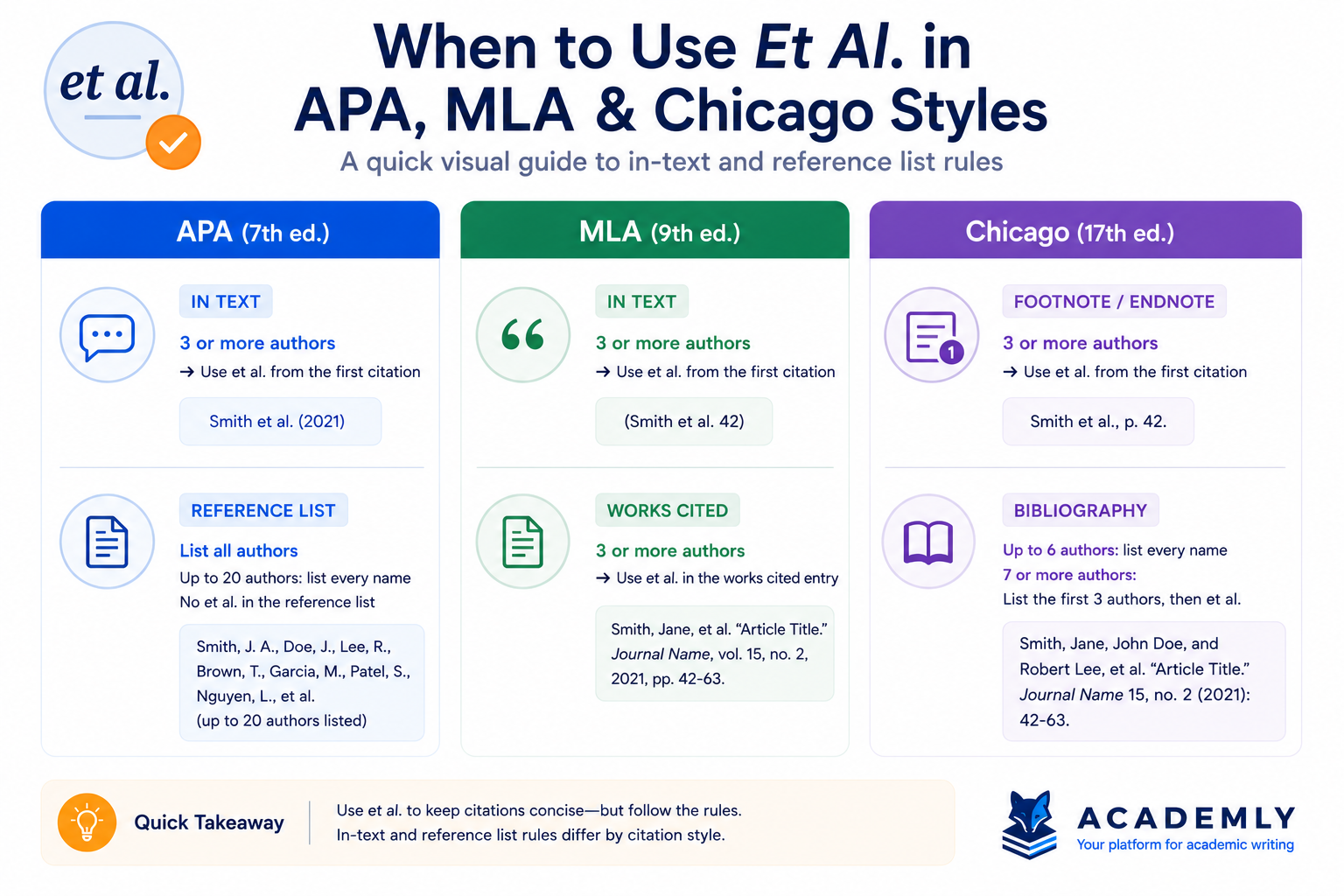
Wysocki, Anne Frances, et al. Writing New Media: Theory and Applications for Expanding the Teaching of Composition. Utah State UP, 2004.
Edited book:
Wolfteich, Claire E., editor. Invitation to Practical Theology: Catholic Voices and Visions. Paulist, 2014.
Chapter in an edited book:
Ross, Colin. "The Story of Grey Owl." Fiction/Non-Fiction: A Reader and Rhetoric, edited by Garry Engkent and Lucia Engkent, Thomson Nelson, 2006, pp. 327-333.
Book with edition number:
Kurlansky, Mark. Salt: A World History. Walker, 2002.
Ebook:
Silva, Paul J. How to Write a Lot: A Practical Guide to Productive Academic Writing. eBook ed., American Psychological Association, 2007.
Translated book:
Beowulf. Translated by Alan Sullivan and Timothy Murphy, edited by Sarah Anderson, Pearson, 2004.
MLA In-Text Citation
Use the author's last name and page number:
(Horowitz 42)
For a narrative citation:
Horowitz argues that... (42)
If there is no page number (ebook), use a chapter number:
(Silva, ch. 3)
Key MLA Rules for Books
- Book title in italics, title case (all principal words capitalized)
- Publisher name can be abbreviated: "University Press" becomes "UP"
- City of publication is generally not required in MLA 9th edition
- For edited books, add "editor" or "editors" after the name
- For ebooks accessed on a device, add "eBook ed." after the title
- Three or more authors: list first author followed by "et al."
Chicago Format: How to Cite a Book
Chicago style (Notes-Bibliography) uses footnotes for in-text references and a bibliography at the end. The format differs between the first (full) footnote and subsequent shortened footnotes. Purdue OWL's Chicago guide provides the standard reference for these rules.
Chicago Notes-Bibliography: First Footnote
First Name Last Name, Title of Book (City: Publisher, Year), page number.
Example:
- Robert M. Sapolsky, Behave: The Biology of Humans at Our Best and Worst (New York: Penguin Books, 2017), 143.
Shortened Footnote (subsequent citations)
Last Name, Shortened Title, page number.
Example:
2. Sapolsky, Behave, 201.
Chicago Bibliography Entry
Last Name, First Name. Title of Book. City: Publisher, Year.
Example:
Sapolsky, Robert M. Behave: The Biology of Humans at Our Best and Worst. New York: Penguin Books, 2017.
Chapter in an edited book:
Footnote:
- Louise Aron, Maud Botella, and Todd Lubart, "Culinary Arts: Talent and Their Development," in The Psychology of High Performance, ed. Rena F. Subotnik, Paula Olszewski-Kubilius, and Frank C. Worrell (Washington, DC: American Psychological Association, 2019), 347.
Bibliography:
Aron, Louise, Maud Botella, and Todd Lubart. "Culinary Arts: Talent and Their Development." In The Psychology of High Performance, edited by Rena F. Subotnik, Paula Olszewski-Kubilius, and Frank C. Worrell, 345-359. Washington, DC: American Psychological Association, 2019.
Chicago Author-Date
Reference list:
Sapolsky, Robert M. 2017. Behave: The Biology of Humans at Our Best and Worst. New York: Penguin Books.
In-text:
(Sapolsky 2017, 143)
Key Chicago Rules for Books
- Chicago Notes-Bibliography still includes city of publication (unlike APA 7th and MLA 9th)
- First footnote: full citation. Subsequent footnotes: shortened form
- Book title in italics
- For edited books, use "ed." (one editor) or "eds." (multiple) in footnotes; "edited by" in bibliography
- Author-Date system: year comes directly after author name
Comparison Table: APA vs MLA vs Chicago for Books
| Element | APA 7th | MLA 9th | Chicago NB |
|---|---|---|---|
| Author format | Last, Initials | Last, First | First Last (footnote) / Last, First (bibliography) |
| Title formatting | Italics, sentence case | Italics, title case | Italics, title case |
| Edition | (2nd ed.) after title | "2nd ed.," after title | (2nd ed.) in parentheses |
| Publisher | Publisher name only | Publisher name | Publisher name |
| City of publication | Not required | Not required | Required |
| Year position | After author in parentheses | End of entry | End of entry |
| In-text format | (Author, Year, p. X) | (Author Page) | Footnote number |
| Edited book label | (Ed.) / (Eds.) | "editor" / "editors" | "ed." / "eds." or "edited by" |
Textbooks: How to Cite Them
A textbook is cited exactly like any other book. There is no special format for textbooks in APA, MLA, or Chicago. The common mistake is treating a textbook differently because it has many authors or a long title.
APA textbook example:
DeMarco, R. F., & Healey-Walsh, J. (2020). Community and public health nursing: Evidence for practice (3rd ed.). Wolters Kluwer.
MLA textbook example:
McEwen, Melanie, and Evelyn M. Wills. Theoretical Basis for Nursing. 6th ed., Wolters Kluwer, 2023.
Chicago textbook example:
DeMarco, Rafaela F., and Judith Healey-Walsh. Community and Public Health Nursing: Evidence for Practice. 3rd ed. Philadelphia: Wolters Kluwer, 2020.
The edition number matters for textbooks because content changes between editions. Always cite the specific edition you used.
Special Cases
Book with No Author
APA: Start the reference with the title. Use a shortened title in in-text citations.
MLA: Start the Works Cited entry with the title.
Chicago: Start the footnote and bibliography entry with the title.
Republished or Classic Book
APA: Include the original publication year at the end in parentheses: "(Original work published 1920)". In-text, cite both years: (Watson & Rayner, 1920/2013).
MLA: Include both the original date and the edition date where relevant.
Chicago: Note the original publication date after the title if relevant to the reader's understanding.
Ebook Without Page Numbers
APA: Cite the chapter number in the in-text citation: (Sapolsky, 2017, Chapter 4).
MLA: Use "ch." followed by the chapter number: (Silva ch. 3).
Chicago: Cite the chapter or section title in the footnote.
One Chapter from an Edited Book
In APA, cite the specific chapter, not the whole book, when you used only one chapter. In MLA, create a separate Works Cited entry for each chapter you used. In Chicago, cite the specific chapter in the footnote and in the bibliography.
Do not cite the whole edited book if you only used one chapter. This is a common mistake that makes it unclear to the reader exactly where your information came from.
Book Accessed via Library Database
APA: Cite as a print book. Do not include the database name. Add a DOI or stable URL if one exists.
MLA: Add the database name and a permalink or DOI after the standard citation.
Chicago: Add the URL or database information after the standard citation.
Common Mistakes When Citing Books
1. Forgetting the edition number
If you use the 3rd edition of a textbook and your citation shows no edition, your reader cannot verify whether they are looking at the same content. Always include the edition for any book that has multiple editions.
2. Using sentence case in MLA
APA uses sentence case for book titles. MLA and Chicago use title case. A student who writes The biology of humans at our best and worst in an MLA citation has applied the wrong convention.
3. Including the city of publication in APA
APA 7th edition no longer requires the city of publication. Including "New York:" before the publisher name is an outdated APA 6th edition format. MLA 9th edition also no longer requires it in most cases.
4. Citing the whole edited book when you only used one chapter
A common shortcut that loses precision. If you used Chapter 5 of an edited volume, cite Chapter 5. Your reader should be able to find exactly what you read, not just the book it appeared in.
5. Citing a textbook's website or companion resource instead of the book
If you used information from the book, cite the book. If you used a resource from the publisher's companion website, cite that website separately. These are different sources.
6. Not recording the edition when you first read the book
A student spent two hours trying to verify whether she had used the 4th or 5th edition of a methodology textbook because she had not noted the edition when she first consulted it. Collect the full citation details, including the edition, before you start reading, not after.
Summary
Citing a book requires four core elements in every style: author, title, publisher, and year. APA uses sentence case for titles and places the year after the author. MLA uses title case and places the year at the end. Chicago uses title case and still requires the city of publication. Edition numbers must always be included when a book has multiple editions. For chapters in edited books, cite the chapter, not the whole volume. Ebooks follow the same format as print books in APA and Chicago; in MLA, note the ebook format when relevant.
Managing Your Book Citations
If you are working with multiple books across different citation styles in a thesis or dissertation, Academly's Citation Manager allows you to upload your PDFs, parse bibliographic information automatically, and export in RIS format for Zotero, Mendeley, or EndNote. All references are generated from sources you have actually uploaded.