How to Cite an Article: APA, MLA and Chicago Format
Citing an article correctly depends on what type of article it is: a peer-reviewed journal article, a newspaper piece, a magazine feature, or something published online. Each type follows slightly different rules across APA, MLA, and Chicago. This guide focuses primarily on journal articles, which are the most common source in academic writing, with clear sections on other article types.
Quick Answer
To cite a journal article in APA 7th edition: Author, A. A. (Year). Article title in sentence case. Journal Title, volume(issue), pages. https://doi.org/xxxxx. In MLA 9th edition: Author Last Name, First Name. "Article Title." Journal Title, vol. number, no. number, Year, pp. pages. DOI or URL. In Chicago Notes-Bibliography: Author First Last, "Article Title," Journal Title volume, no. issue (Year): pages. DOI or URL. The DOI (Digital Object Identifier) should always be included when available, in all three styles.
What Type of Article Are You Citing?
The rules differ slightly depending on the article type. Identify yours before writing the citation.
| Article Type | Typical Source | DOI Available? |
|---|---|---|
| Peer-reviewed journal article | Academic database (JSTOR, PubMed, Scopus) | Usually yes |
| Magazine article | Print or website | Rarely |
| Newspaper article | Print or website | Rarely |
| Online news article | Website | Sometimes |
| Blog post or editorial | Website | No |
This guide focuses on journal articles. For websites and online articles, see how to cite a website (when live).
What Is a DOI and Why Does It Matter?
A DOI (Digital Object Identifier) is a permanent link to a published article. Unlike a URL, it does not change when a publisher moves content between servers. Per the APA Style journal article references page, always include the DOI when one is available.
A DOI looks like this: https://doi.org/10.1037/edu0000946
If an article has no DOI and you accessed it through an academic database (JSTOR, PsycINFO, Web of Science), you do not need to include the database URL in APA. End the reference after the page numbers. If the article has no DOI but has a stable URL on the journal's own website, include that URL instead.
APA Format: How to Cite a Journal Article
APA 7th edition journal article references are covered in Section 10.1 of the APA Publication Manual.
APA Reference List Template
Author, A. A., & Author, B. B. (Year). Article title in sentence case. Journal Title in Title Case, volume(issue), pages. https://doi.org/xxxxx
APA Examples
Journal article with DOI:
Jerrentrup, A., Mueller, T., Glowalla, U., Herder, M., Henrichs, N., Neubauer, A., & Schaefer, J. R. (2018). Teaching medicine with the help of "Dr. House." PLoS ONE, 13(3), Article e0193972. https://doi.org/10.1371/journal.pone.0193972
Journal article without DOI (accessed via database):
Hallion, M., Taylor, A., Roberts, R., & Ashe, M. (2019). Exploring the association between physical activity participation and self-compassion in middle-aged adults. Sport, Exercise, and Performance Psychology, 8(3), 305-316.
Online magazine article:
Thomson, J. (2022, September 8). Massive, strange white structures appear on Utah's Great Salt Lake. Newsweek. https://www.newsweek.com/mysterious-mounds-great-salt-lake-utah-explained-mirabilite-1741151
Newspaper article (online):
Bernstein, J. (2024, June 3). The man who couldn't stop going to college. The New York Times. https://www.nytimes.com/...
APA In-Text Citation
Use the author's last name and year:
(Jerrentrup et al., 2018)
For a direct quote, add the page number or paragraph number:
(Jerrentrup et al., 2018, p. 3)
For a narrative citation:
Jerrentrup et al. (2018) found that...
Key APA Rules for Articles
- Article title in sentence case (only first word, proper nouns, and first word after a colon capitalised)
- Journal title in italics and title case
- Volume number in italics, issue number in parentheses (not italicised)
- Always include the DOI as a full URL (
https://doi.org/...), not just the number - For articles from databases without a DOI, end after page numbers
- Always include the issue number, even for journals paginated continuously
MLA Format: How to Cite a Journal Article
MLA 9th edition uses the container system. A journal is the container for an article. Guidance is available on the MLA Style Center.
MLA Works Cited Template
Author Last Name, First Name. "Article Title in Title Case." Journal Title, vol. number, no. number, Year, pp. start-end. DOI or URL.
MLA Examples
Journal article with DOI:
Smith, Jane A., and Robert B. Jones. "Digital Literacy in Higher Education." Journal of Educational Technology, vol. 15, no. 2, 2023, pp. 123-145. https://doi.org/10.1234/jet.2023.15.2.
Journal article without DOI (database access):
Wolf, Michael. "Climate Adaptation in Urban Settings." Environmental Policy Review, vol. 8, no. 1, 2021, pp. 44-67. JSTOR, www.jstor.org/stable/XXXXXXX.
Online magazine article:
Thompson, Rachel. "The Future of Remote Work." The Atlantic, 14 Mar. 2023, www.theatlantic.com/...
Newspaper article:
Goodman, Peter S. "Hurricane Ida Could Make the Supply Chain Disaster Even Worse." The New York Times, 31 Aug. 2021, www.nytimes.com/...
MLA In-Text Citation
Use the author's last name and page number. If no page number, use just the author name:
(Smith and Jones 130)
For a narrative citation:
Smith and Jones argue that... (130)
Key MLA Rules for Articles
- Article title in quotation marks, title case
- Journal title in italics, title case
- Use "vol." and "no." before volume and issue numbers
- Use "pp." before page range
- Include DOI as a full URL, or database name and URL if no DOI
- Use "n. pag." if no page numbers are available
Chicago Format: How to Cite a Journal Article
Chicago style uses either Notes-Bibliography (humanities) or Author-Date (social sciences). The Purdue OWL Chicago guide provides comprehensive examples.
Chicago Notes-Bibliography: Footnote
First Name Last Name, "Article Title," Journal Title volume, no. issue (Year): pages. DOI or URL.
Example:
- Adam Meehan, "Repetition, Race, and Desire in The Great Gatsby," Journal of Modern Literature 37, no. 2 (2014): 78. https://doi.org/10.2979/jmodelite.37.2.76.
Shortened footnote on subsequent citations:
2. Meehan, "Repetition, Race, and Desire," 80.
Chicago Notes-Bibliography: Bibliography Entry
Last Name, First Name. "Article Title." Journal Title volume, no. issue (Year): pages. DOI or URL.
Example:
Meehan, Adam. "Repetition, Race, and Desire in The Great Gatsby." Journal of Modern Literature 37, no. 2 (2014): 76-99. https://doi.org/10.2979/jmodelite.37.2.76.
Chicago Author-Date
Reference list:
Last Name, First Name. Year. "Article Title." Journal Title volume (issue): pages. DOI or URL.
Example:
Smith, John. 2020. "The Impact of Climate Change." Journal of Environmental Studies 10 (2): 12-20. https://doi.org/10.xxxxx.
In-text (Author-Date):
(Smith 2020, 14)
Key Chicago Rules for Articles
- Article title in quotation marks, title case
- Journal title italicised
- Volume and issue written as "volume, no. issue" (not in parentheses)
- Year in parentheses in Notes-Bibliography; after author name in Author-Date
- Include DOI as full URL; if no DOI, include the database or URL
Comparison Table: APA vs MLA vs Chicago for Journal Articles
| Element | APA 7th | MLA 9th | Chicago NB |
|---|---|---|---|
| Article title | Sentence case, no formatting | "Quotation marks", title case | "Quotation marks", title case |
| Journal title | Italics, title case | Italics, title case | Italics, title case |
| Volume | Italics, no label | "vol." before number | Number, no label |
| Issue | In parentheses, no label | "no." before number | "no." before number |
| Year position | After author | Near end | In parentheses after issue |
| Page range | Plain text | "pp." before range | Plain text after colon |
| DOI format | https://doi.org/xxxxx | https://doi.org/xxxxx | https://doi.org/xxxxx |
| In-text anchor | Author + year | Author + page | Author + year or footnote |
Special Cases
Article with More Than Three Authors
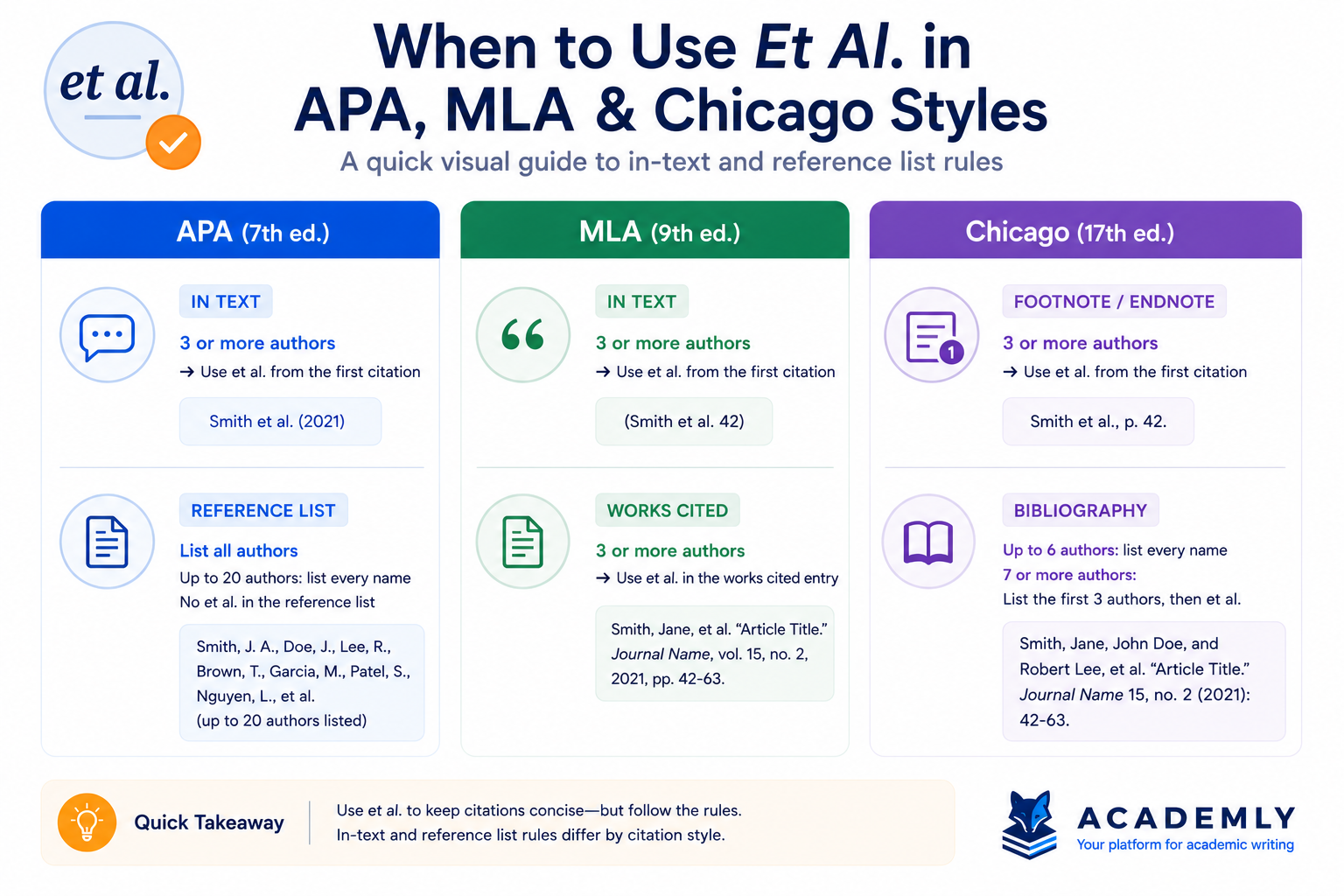
APA: List all authors in the reference list. In-text, use the first author's name followed by "et al." for works with three or more authors: (Smith et al., 2020).
MLA: List up to two authors. For three or more, list the first author followed by "et al.": Smith et al.
Chicago: In footnotes and bibliography, list all authors up to ten. For more than ten, list the first seven followed by "et al." In-text Author-Date citations, use "et al." from the first citation for works with four or more authors.
Article with No DOI
APA: If the article is from an academic database without a DOI, end the reference after the page range. Do not include the database URL. If the article is on the journal's own website with a stable URL, include that URL.
MLA: Include the database name and URL or stable URL if no DOI is available.
Chicago: Include the URL of the article or the database name.
Article in a Language Other Than English
APA: Translate the article title into English in square brackets after the original title. Keep the journal name in the original language.
MLA: Include the original title and add the translation in square brackets if relevant to your reader.
Chicago: Use the original title; add a translated title in brackets if helpful.
Citing an Article in an Essay (In-Text Placement)
Cite in-text immediately after the information you have drawn from the source, not at the end of a paragraph. If you paraphrase a point across several sentences without changing the source, cite at the end of the first sentence and again at the end of the last.
Do not bundle multiple citations into one parenthetical at the end of a long paragraph. This makes it unclear which information comes from which source.
Retracted Article
If you need to cite an article that has since been retracted, note the retraction in your text and include both the original citation and the retraction notice in your reference list. In APA, add "(Retraction published Year, Journal, volume[issue], page)" after the DOI in the reference.
Common Mistakes When Citing Articles
1. Using the wrong case for the article title
APA uses sentence case for article titles: only the first word, proper nouns, and the first word after a colon are capitalised. MLA and Chicago use title case. This is one of the most common errors when moving between styles.
2. Omitting the issue number
APA requires the issue number for all journal articles, even if the journal uses continuous pagination. Writing Journal of Psychology, 45, 123-134 without the issue number is incorrect. It should be 45(3), 123-134.
3. Formatting the DOI incorrectly
The DOI should always appear as a full URL: https://doi.org/10.xxxxx. Writing just doi: 10.xxxxx or DOI: 10.xxxxx is outdated APA 6th edition format. In APA 7th, always use the full hyperlink format.
4. Including the database name in APA when not needed
APA does not require database names (JSTOR, PsycINFO, etc.) for widely available articles. If the article has a DOI, use that. If it does not, end after the page range. Writing "Retrieved from JSTOR" is outdated.
5. Confusing volume and issue numbers
Volume is the annual set of issues. Issue is the number within that volume. Volume 45, issue 3 means the third issue published in the 45th year of the journal's run. Getting these reversed produces an incorrect citation.
6. Citing a database landing page instead of the article
Copy the DOI or the article's own stable URL, not the URL of your search results page. A search results URL will not work for anyone else.
Summary
Citing a journal article requires four elements in all styles: author, year, article title, and journal information (title, volume, issue, pages). The DOI should always be included when available as a full URL. The main formatting differences are: APA uses sentence case for the article title; MLA and Chicago use title case. APA italicises the volume number; MLA and Chicago do not. In APA, the issue number goes in parentheses with no label. In MLA it is preceded by "no." In Chicago it follows "no." with no parentheses.
Managing Your Reference List
When you are working across multiple article types and styles in a thesis or dissertation, keeping citations consistent is time-consuming to do manually. Academly's Citation Manager parses bibliographic information from your uploaded PDFs automatically and exports in RIS format for Zotero, Mendeley, or EndNote. All citations are generated from sources you have actually uploaded, not from a general knowledge base.